
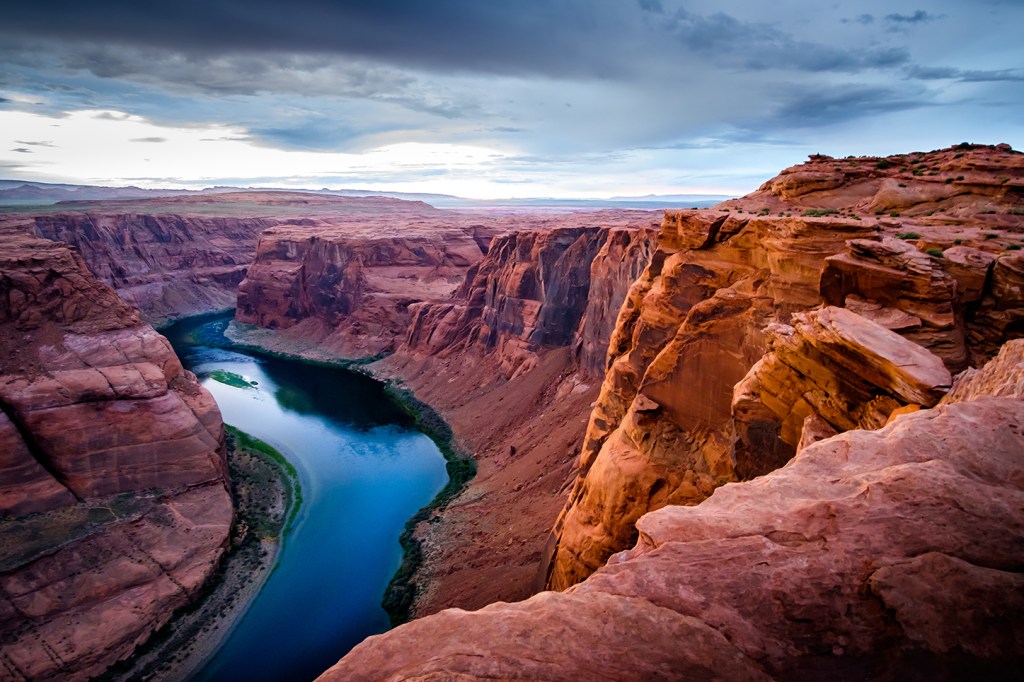
As many of our readers may be aware, the Colorado River has been a focus in recent news after a major multi-state agreement announced in May 2023 indicated that the federal government will compensate $1.2 Billion to municipalities, water districts and Tribal Nations in Arizona, California and Nevada in exchange for reducing water consumption. Although these recent developments bring some measure of progress to a complex, decades-long issue, it is far from resolved. Many Tribal Nations of the Western and Pacific Regions have yet to achieve settlement agreements with the federal government, and the lack of access to water in the areas has reached crisis levels.
The recently announced agreement inspired us to look back at NCAI’s historical involvement in the fight for Tribal Nations’ access to the natural resources of the Colorado River that they’ve relied on for millenia. After consulting archival records at the Smithsonian National Museum of the American Indian, we found that NCAI began addressing water rights much earlier than we originally suspected. In fact, shortly after its 1944 conception, NCAI leaders and advocates brought water rights to the national agenda.
In 1948, just four years after its founding, the question of water rights emerged in the NCAI archival records. A resolution at NCAI’s 5th Annual Convention—held in Denver, Colorado—boldly called for a complete reorganization of the Bureau of Indian Affairs (BIA), from the reservation-level to Washington, D.C. As part of a larger plan adopted at the end of the convention, NCAI called on the BIA to review all treaties, executive orders, laws, and regulations affecting Tribal Nations. The goal was to ensure adequate provisions for the protection of tribal water rights. This call to action is the first time we see water rights specifically addressed in any NCAI policy initiatives.
The following year, NCAI leaders sprang into action. The (then-called) Phoenix Area Region held the first ever regional conference in 1949, with a focus on water rights. Designed as a gathering of all Southwestern Tribal Nations from Arizona, New Mexico, Utah and Colorado, the meeting brought together 125 delegates from 19 Tribal Nations, along with the Governor of Arizona, to address Indian water rights of the Colorado River.
Also in 1949, NCAI voiced its opposition to several Congressional bills seeking to create irrigation projects that would divert water from the Colorado River and endanger water access on reservations in Arizona. Representatives from the Gila River Indian Community, Salt River Pima-Maricopa Indian Community and The Hualapai Tribe attended the 6th Annual NCAI Convention held in Rapid City, South Dakota, to express their opposition to the proposed projects. Warning that these projects would cut off a vital source of their water supply, NCAI leaders exclaimed, “We are objecting to this high handed method of handling our resources.”
As the years progressed, stronger and more sharply focused statements on the Colorado River crisis rose to a crescendo. In 1953, a resolution “Requesting Protection of Indian Water Rights” was adopted at the 10th Annual NCAI Convention in Phoenix, Arizona. Beginning as a traditional policy resolution, it grew in scope and transformed into a much larger and more comprehensive statement on the organization’s emerging approach to water rights. The end result was NCAI leaders boldly calling out the federal government for abandoning their responsibility to protect tribal water rights in the region.
In addition to noting that the lives of 65,000 Indians in the region were at stake, this strongly worded resolution—which was originally conceived as a plea for help— demanded that President Dwight D. Eisenhower and his administration fulfill their obligations to Tribal Nations in three specific ways: First, the Administration must agree to, and assert, the “prior and superior” rights of Indians to use the water on the Colorado River; Second, the Administration must consult with Tribal Nations on all matters and provide files, data, and research relating to the river to Tribal Nations; and third, the Administration must prevent anyone from intervening with Indians’ access to the water. In short, this resolution asserted that the government must pledge to protect and assist Tribal Nations in defense of their water rights.
In this statement, NCAI relied on a 1908 Supreme Court decision Winters v. United States. The Winters Doctrine holds that water rights were implicitly reserved at the time a reservation was created, and that federal reservation of lands for tribal homelands implied enough access to water “sufficient to fulfill the purpose of the reservation”. This doctrine is used in water settlement cases to this day. The three-page long resolution topped all other matters on the agenda at the 1953 Annual Convention and was unanimously adopted by the 52 Tribal Nation delegates in attendance.
When speaking about the resolution, NCAI leaders used language that is remarkably similar to that used today—exactly 70 years later. Leaders stressed the need to act in unity to protect natural resources and warned that, if the issue is neglected, development would leave Tribal Nations stranded without any realistic way towards securing water rights and rights over the remaining precious resources which they rightfully own. Throughout the remainder of the 1950s, NCAI leaders expanded upon this powerful statement. Subsequent resolutions address water rights with more specifics, focusing on agriculture, farming, and economic development. Tribal leaders continued to emphasize how overdevelopment of land by non-Indians had jeopardized the river through water depletion. NCAI leaders reiterated the U.S. government’s moral responsibility to assist Tribal Nations in the region with securing their water rights. They also issued a dire warning: Keep up the pace or “political forces aligned with economic interests would eliminate Indian water rights” altogether.
When NCAI first became involved in advocacy of the Colorado River region, leaders expressed hope that, “Well thought out plans [were] being written in Arizona, so that it may well be the dawning of a new day for Indian People across the nation.” These initial years of Indian water rights defense set the stage for the decades to come, serving as the blueprint for NCAI’s water rights advocacy that later spread across the country. We recognize that the issue discussed here is complex and yet to be resolved. And while this look back at NCAI history is far from comprehensive, we hope it sparks interest in Indian water policy for our readers. If you would like to learn more, please listen to the NCAI Sentinel Podcast at ncai.org/sentinel.
 The Sentinel