
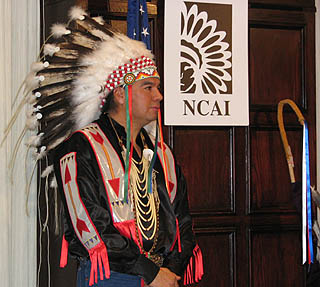
Every year, the NCAI President delivers the State of Indian Nations address to members of Congress, government officials, tribal leaders and the public. Frequently, the address is appropriately given during the same week as the U.S. President’s State of the Union address.
The purpose of the State of Indian Nations address is to lay out Indian Country’s successes and challenges from the previous year, and present Tribal Nations’ hopes and plans for the new year. The first State of Indian Nations address was delivered in 2003 by then-NCAI President Tex Hall (Mandan, Hidatsa and Arikara Nation). President Hall spoke before an audience at the National Press Club in Washington, DC, on January 31, 2003. The address was also broadcast over the C-SPAN network.
Pointing out that, “Since the time of George Washington, U.S. Presidents have offered an annual message to Congress, highlighting our country’s successes, and mapping a course forward through the challenges of the day,” President Hall then expressed pride at being the first NCAI President to begin a similar tradition for Tribal Nations.
Hall used the theme, “Looking Back Seven Generations,” to frame the entirety of his speech. He began by asking the audience, “Seven generations after the darkest days our people have faced, we have survived and thrived. [W]hat will things look like seven generations from now?”
Three overarching themes ran through the hour-and-a-half long speech. President Hall reminded the audience that the survival of Tribal Nations depended on the government-to-government relationship between Tribal Nations and the United States. Stressing that Tribal Nations must be seen as governments and their citizens as independent, self-governing peoples, Hall touched on issues of tribal sovereignty, self-determination, and jurisdiction.
Stressing the importance of economic development, Hall then spoke about the challenges of infrastructure on reservations, as well as telecommunications, gaming, taxation, welfare reform, bureaucratic impediments, and housing in Indian Country.
After he referenced what life would be like for the next seven generations, President Hall turned his attention to the issues of health and education, sharing statistics on life expectancy, disease, education, and environmental protection.
When asked by an audience member why NCAI decided to offer this first-ever State of Indian Nations speech, President Hall pointed out that the timing was right. The Bush Administration needed to hear from Indian Country, especially with respect to current legislation and policies being considered at the time. As for the specifics, he explicitly asked the Administration and government officials to enact an economic stimulus package aimed at Indian Country, provide support in funding for infrastructure and telecommunications, and to reauthorize the Indian Health Care Improvement Act.
The speech concluded with a poignant question: “What will be our legacy seven generations from now? We look forward to a bright future for the seven generations to come and beyond, with roots in the past, flourishing in the future, if only we can work together today.”
Looking back and looking forward has been the foundation of every State of Indian Nations since the very first in 2003. This year’s State of Indian Nations address is the 22nd such speech and was delivered by NCAI President Mark Macarro (Pechanga Band of Indians) on February 12, 2023 at the Warner Theatre in Washington, DC. There is no doubt this will be an annual tradition for years to come.
 The Sentinel